Al-Munya
The house
The rule of the two houses
Two houses, two entrances, two kitchens, two circulations. One common wall, with a door openable only from the Riad's side.
Nothing is arranged for accumulation or for display. Each space answers a precise use and a rule of measure.
Al-Munya exists to allow, discreetly and over time, what the Riad, a house of formation, cannot and should not be.
Service
Dining room
A complete independent kitchen. Its separation from the Riad's kitchen is total and not negotiable.
Service rooms
Accessible to the Munya's staff alone, by separate circulations.
Discreet store
For textiles, valuable pieces and objects kept out of sight. Few things, each in its place.

The rooms and their decoration
The six guest rooms are of contained proportion, with single beds and an adjoining bathroom. Their quality is read in the material and in the execution rather than in the floor area, after the manner of the great houses of Fez, where the room serves for rest and the day is spent in the hall, the salon and under the porticoes of the courtyard.
The walls take zellij as a dado and carved stucco above, the ceilings are coffered in painted cedar, the doors are carved and turned-wood lattices fill the windows. The carpets are old and of the first quality, the printed velvet cushions carry Byzantine and Sasanian motifs in the manner of Mariano Fortuny, and the light comes from silk lanterns of the cesendello and scudo saraceno kind.
Everything there belongs to a tradition executed at its highest degree, and nothing is borrowed from the hotel trade: no series furniture, no conventional decoration, no equipment left in view.
Why such richness, in a project of this kind
The guest whom the residents one day invite to cross the low, narrow door of the common wall passes from a house where he lacks nothing to a house that owns almost nothing, and it is there, before the common life, the study and the craft of these young men, that he measures how little weighs what he has just left.
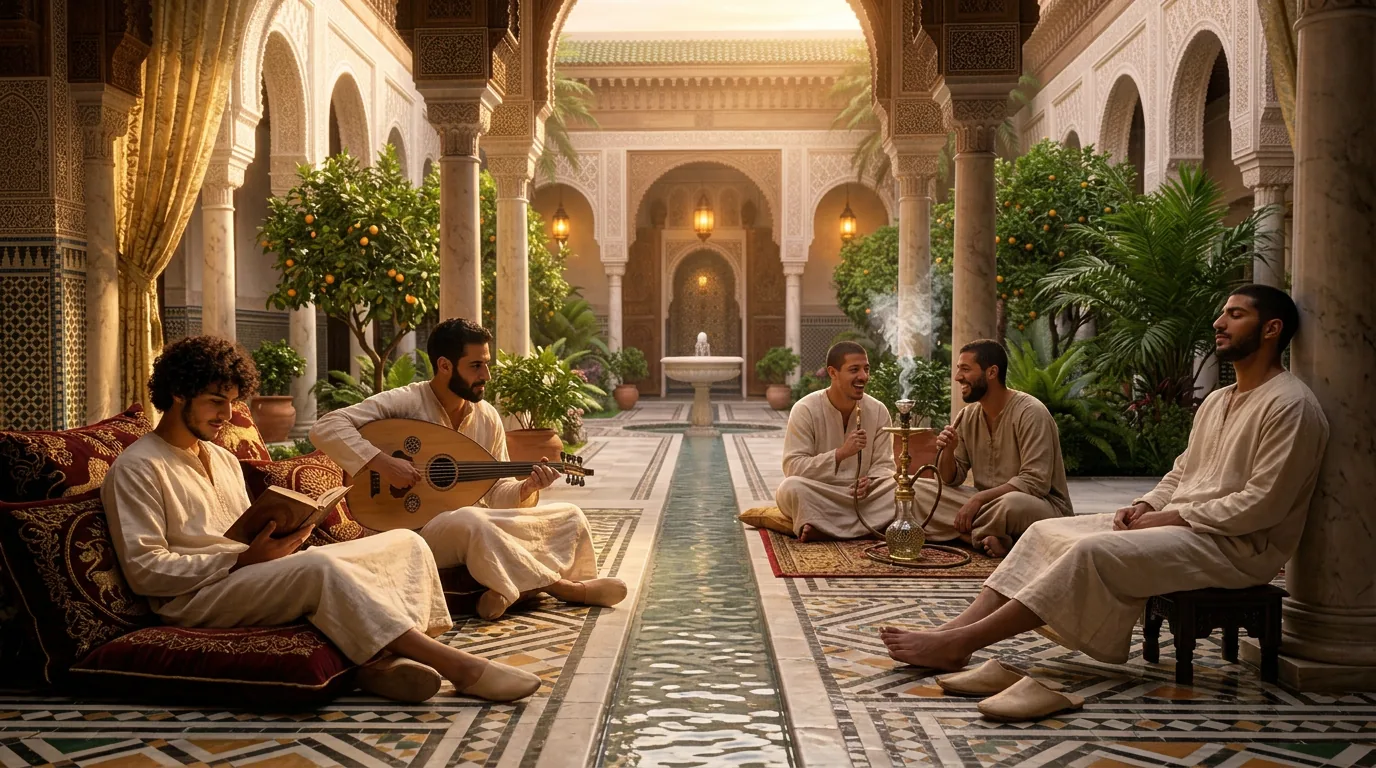
This is why the house receives without distinction the son of a poor family and the son of a well-off one, come to spend a time of common life and form his character. Both wear the same undyed linen qamis, eat at the same table, work in the same workshop, pray at the same hour and sleep in the same dormitory.
The first finds there something with which to redeem a past of humiliations; the second learns humility, and to obey before commanding, in a house where his fortune buys him nothing. Each is judged and esteemed for what he is rather than for what he owns.